AI
- Home /
- Categories /
- AI

AI Agents Are Starting to Shop for You — Here's What They Can (and Can't) Do Without Asking
Somewhere between “AI that answers questions” and “AI that runs your life” sits a category that’s growing fast in 2026: AI shopping agents — tools that can browse a store, compare options, fill in your payment details, and in a growing number of cases, actually complete the purchase, with only a light touch of human approval along the way. According to Braze’s 2026 Customer Engagement Review, 14% of UK consumers already let an AI agent transact on their behalf, and that number is projected to almost triple to 37% by the end of the year. That’s not a niche behavior anymore — it’s a trend moving fast enough that most people using these tools haven’t stopped to check exactly what permissions they’ve handed over.
Read More
Is That Urgent Call Really Them? How to Spot an AI Voice Clone Scam (2026)
Your phone rings. It’s a number you don’t recognize, but the voice on the other end is unmistakably your daughter, your father, or your brother — shaking, scared, asking you not to tell anyone, and asking for money right now. This exact setup — a frantic call posing as a relative in crisis — is common enough to have its own established name: the grandparent scam, a term the FTC and FCC use for this style of family-emergency fraud even when the caller claims to be a grandchild, a sibling, a parent, or a close friend rather than literally a grandchild calling a grandparent. The voice is right. The panic in it sounds real. And increasingly, in 2026, neither of those things means the call is genuine. Modern AI voice-cloning tools can now recreate a familiar voice convincingly from just a few seconds of audio pulled off a social media video, a voicemail greeting, or a podcast clip — which is exactly why an AI voice cloning scam call is one of the hardest scams to catch by ear alone, and one of the most important to know how to check.
Read More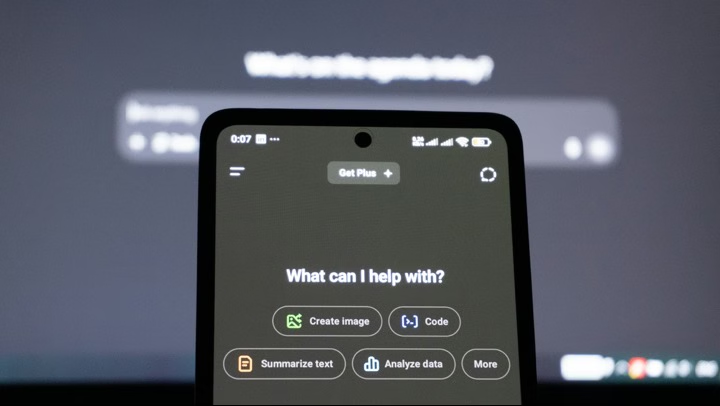
You're Probably Overpaying for AI: Do You Really Need ChatGPT Plus, Claude Pro, and Gemini Advanced?
If you’ve stacked ChatGPT Plus, Claude Pro, and Google’s AI Pro plan “just in case,” you’re paying somewhere around $60 a month for three products that mostly do the same thing. That’s not a hypothetical — it’s an easy trap to fall into once every AI company has convinced you their model is the one you can’t live without for at least one specific task. This isn’t another “ChatGPT vs Claude vs Gemini” price table; you can find a dozen of those already. It’s a framework for figuring out which subscription — if any — you actually need, and when paying by usage beats paying by the month entirely.
Read More
Gemini's Free AI Image Generator Is Now Live in India — How "Nano Banana" Personalized Images Work
Google just removed the paywall on one of Gemini’s most talked-about features. Personalized AI image generation — built on Google’s “Nano Banana” image model — was locked behind a Gemini Plus, Pro, or Ultra subscription. As of late June 2026 it’s free, and the rollout has already reached India and Japan alongside the US. If you’ve seen AI-generated images that somehow look like you, in your style, without a detailed prompt — this is how.
Read More
Why Phones Are Getting More Expensive in 2026 — Blame the AI Chip Shortage
Your next phone is going to cost more — and it’s not inflation, tariffs, or a new camera gimmick. It’s RAM. Samsung just pushed through a 20% DRAM price hike for Q3 2026, the latest jolt in a memory chip shortage that’s already made phones and laptops noticeably pricier this year. The culprit isn’t even the phone industry — it’s AI.
Read More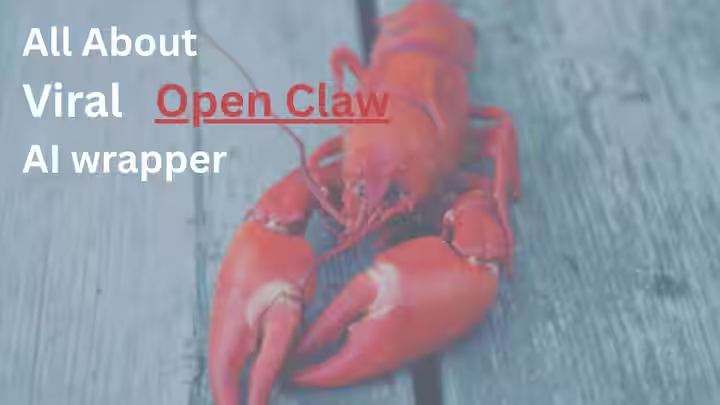
OpenClaw Explained — What This Viral AI Wrapper Is and How to Use It
OpenClaw has been going viral as one of the most talked-about open-source AI agents of 2025–2026. Even so, many people still ask: what is OpenClaw, how does it work, and how can you actually use it? This article breaks it down in simple terms — what this AI wrapper is, how you can take advantage of it, and why the Mac Mini has become a popular choice for running it at home.
Read More
The AI Revolution Is Thirsty — How Much Water Does ChatGPT Really Use?
One prompt. One tiny drop of water. At least, that’s how Sam Altman has framed it: a single ChatGPT interaction might use about 1/15 of a teaspoon of water. Multiply that by a billion messages a day to ChatGPT alone — plus Gemini, Claude, DeepSeek, and the rest — and the picture changes fast.
Read More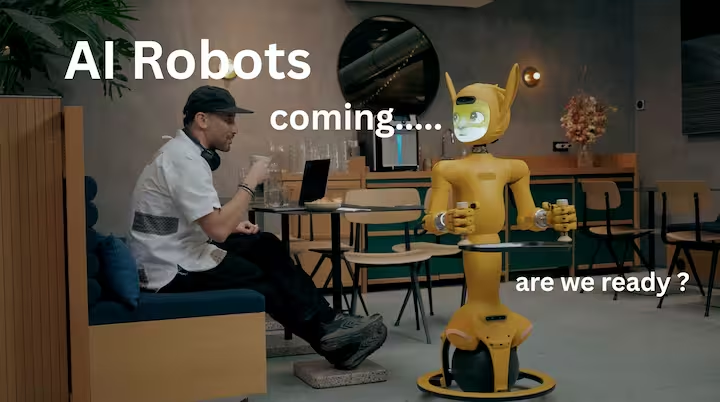
Domestic AI Robots Are Coming — Will They Replace Human Home Help?
For years, the idea of a robot butler was pure sci‑fi. Now, billions of dollars are flowing into startups racing to build domestic AI robots that can tidy your living room, fold laundry, wipe counters, and maybe even make your coffee.
Read More
AI Layoffs Might Save Money Today — But They’re Destroying Tomorrow’s Talent Pipeline
Layoff headlines exploded at the end of 2025. At the same time, generative AI tools quietly became powerful enough to handle a lot of the work that used to be done by junior employees and middle managers.
Read More
Project Stargate — What Is the $500B OpenAI Mega Data Center in Texas?
A $500 billion bet on AI is taking shape in the red dirt of West Texas. It’s called Project Stargate — and if you haven’t heard the name yet, you likely will. OpenAI, SoftBank, and Oracle are building what could become one of the world’s largest AI compute clusters in Abilene, Texas. Here’s what’s actually happening, why it’s there, and what it means for the future of AI.
Read More