Is That Urgent Call Really Them? How to Spot an AI Voice Clone Scam (2026)
- Vikram Singh Shahi
- Technology , Ai
- July 21, 2026
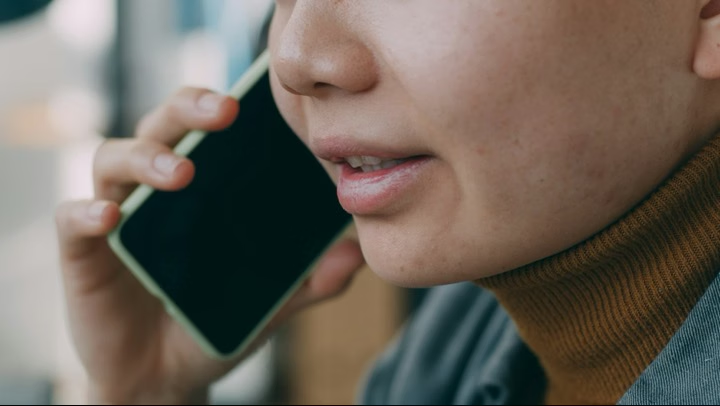
Your phone rings. It’s a number you don’t recognize, but the voice on the other end is unmistakably your daughter, your father, or your brother — shaking, scared, asking you not to tell anyone, and asking for money right now. This exact setup — a frantic call posing as a relative in crisis — is common enough to have its own established name: the grandparent scam, a term the FTC and FCC use for this style of family-emergency fraud even when the caller claims to be a grandchild, a sibling, a parent, or a close friend rather than literally a grandchild calling a grandparent. The voice is right. The panic in it sounds real. And increasingly, in 2026, neither of those things means the call is genuine. Modern AI voice-cloning tools can now recreate a familiar voice convincingly from just a few seconds of audio pulled off a social media video, a voicemail greeting, or a podcast clip — which is exactly why an AI voice cloning scam call is one of the hardest scams to catch by ear alone, and one of the most important to know how to check.
This is the same “verify before you trust” instinct we’ve written about with fake festive-sale discounts and “no cost” EMI offers — a convincing surface isn’t proof, and there’s now a specific, fast way to check what’s actually happening underneath it.
How the scam actually works
The mechanics are simpler, and cheaper, than most people assume. A scammer needs three things: a short audio sample of the person they’re impersonating, a voice-cloning tool, and a script.
The audio sample is the easy part. Security researchers and outlets covering this trend, including CNN and Fox News, have reported that current AI voice-cloning tools need as little as three seconds of clear audio to build a usable clone — easily lifted from a public Instagram reel, a YouTube interview, a podcast appearance, or even a voicemail greeting. McAfee’s own research backs this up: three seconds is enough to produce a voice match convincing enough that most listeners can no longer reliably tell it apart from the real person on a phone call, where audio quality is already compressed and imperfect.
From there, the tool itself is often inexpensive and requires no special expertise — some voice-cloning services cost less than a typical monthly streaming subscription. The scammer feeds the cloned voice a script, sometimes generated live in real time so the “voice” can actually respond to whatever the victim says, rather than playing a single pre-recorded line. The most common framing is a fabricated emergency: a car accident, an arrest, a kidnapping threat, a medical crisis — engineered specifically to short-circuit the slow, careful thinking a real financial decision deserves, and to demand money fast, quietly, and through a channel that’s hard to reverse: wire transfers, gift cards, or a crypto payment.
One scripted element deserves to be called out on its own, separate from the general urgency: the instruction to keep it secret. “Please don’t tell anyone,” “don’t call the police yet,” “don’t tell mom” — this isolation tactic shows up across nearly every version of the family-emergency script, precisely because it stops a victim from checking the story with anyone else who might immediately recognize it as fake. A real emergency essentially never comes bundled with an explicit demand for secrecy from your own family. Treat that instruction, on its own, as a red flag equal in weight to the request for money itself.
The FBI’s Internet Crime Complaint Center (IC3) reported that Americans lost roughly $352 million in elder-fraud complaints referencing AI in 2025, with more than 3,100 complaints from seniors specifically citing AI involvement — a category that includes exactly this kind of voice-cloned “family emergency” call. This isn’t a hypothetical harm; it’s an active, growing, and well-documented one.
That FBI figure captures reported fraud losses in the US specifically, but McAfee’s own global research shows how widespread the underlying experience already is. In a survey of 7,054 people across seven countries, McAfee found that roughly one in four adults had already experienced some kind of AI voice scam, one in ten said they’d been personally targeted, and 77% of those targeted lost money as a result — with some victims reporting losses as high as $15,000. That survey is a few years old at this point, but the pattern it captured has only accelerated as voice-cloning tools have gotten cheaper and more convincing since.
The scale this technology can reach isn’t limited to a single victim on a phone call, either. In February 2024, a finance employee at the Hong Kong office of the multinational engineering firm Arup was convinced to move company funds after joining what looked like a routine video conference with the firm’s UK-based CFO and several colleagues — every one of whom, it turned out, was a deepfake. Hong Kong police confirmed the employee ended up authorizing 15 separate transactions totaling roughly $25 million (HK$200 million) before the fraud was discovered, a week later, when he checked in with company headquarters directly. It’s a corporate case rather than a family-emergency one, but it remains one of the clearest illustrations on record of how far real-time deepfake technology has already been weaponized — video included, not just voice.
Case study: India’s “digital arrest” scam wave
One especially elaborate version of this scam has surged in India and is worth understanding as a case study, even if you never expect to encounter it yourself — because the underlying technique (a convincing fake voice plus manufactured urgency) is the exact same pattern showing up worldwide in smaller forms.
In the Indian “digital arrest” scam, callers impersonate police, customs, or central investigative officials, often over video call, complete with fake uniforms, forged court documents, and backdrops designed to look official. They tell the victim their Aadhaar number, a parcel, or a bank account is linked to a crime — money laundering, drug trafficking, courier fraud — and that they’re now under a so-called “digital arrest”: ordered to stay on the call, cut off from contacting anyone else, while they transfer money to “verify” their innocence. India’s Press Information Bureau has published an explicit public advisory confirming that no law in India provides for anything called a “digital arrest” — any real arrest requires a physical, in-person process with a written warrant. Scammers increasingly layer AI-generated voices and deepfaked video of “senior officers” into these calls to make the impersonation more convincing.
If you ever find yourself on a video call like this and something feels off, there’s a simple, practical test worth trying before you do anything else: ask the person to turn their head to the side, or to wave a hand quickly in front of their face. Real-time video deepfakes are typically generated from front-facing footage, and researchers who study this technology have repeatedly found that the illusion still breaks down badly on a full side profile and on fast motion — the face can blur, distort, ghost, or noticeably lag behind the movement. It isn’t a guaranteed test, and it won’t help against a pre-recorded video, but it costs nothing to try, and it targets exactly the kind of movement current deepfake video technology still struggles to fake convincingly in real time.
According to Ministry of Home Affairs data via India’s Indian Cyber Crime Coordination Centre (I4C), digital-arrest-style complaints surged 103% to roughly 1,23,672 cases in 2024, with reported losses jumping 465% to about ₹1,918 crore that year. The picture hasn’t improved since. In October–November 2025, the Supreme Court of India took suo motu notice of the scam wave and was told nationwide losses had climbed to nearly ₹3,000 crore; the bench called the figure “shocking” and ordered a nationwide, CBI-coordinated probe. Prime Minister Modi raised the scam again in his February 2026 Mann Ki Baat address, urging citizens to stay alert and to verify any KYC or bank-account request only through official channels rather than a caller. In March 2026, the Ministry of Home Affairs went a step further, directing WhatsApp to permanently block the device IDs — not just the accounts — of repeat digital-arrest scammers, alongside SIM-binding requirements and AI tools meant to flag impersonation of law enforcement, an acknowledgment that blocking phone numbers and accounts alone hadn’t been enough to slow the wave. India’s cybercrime helpline, dial 1930, and the National Cyber Crime Reporting Portal exist specifically to handle these reports quickly. The core lesson generalizes well beyond India: legitimate law enforcement, anywhere in the world, does not conduct arrests over a phone or video call, and does not ask for payment to avoid one.
The verification checks that actually work
None of the checks below require special technology. They work because they force the call into a shape a scammer — even one running a live AI voice clone — has a hard time faking.
1. Hang up and call back on a number you already have. Not the number that called you, not a number the caller gives you, not a callback number in a text they send afterward — the actual saved contact number, or a number you look up independently. This single step defeats the scam almost every time, because the scammer’s entire setup depends on you staying on their line. This matters even if the number on your screen looked exactly right — the FCC has published specific consumer guidance confirming that caller ID can be spoofed: scammers can make virtually any number display, including a real family member’s actual saved number or a real government agency’s official line. A correct-looking caller ID is not, by itself, verification of anything. Only a callback you initiate, to a number you already trust, is.
2. Agree on a family codeword in advance. This is now explicit guidance from the FTC and the FBI: pick a word or phrase with close family members that isn’t posted anywhere public, and treat any emergency call that can’t produce it as suspect. If the caller stalls, changes the subject, or claims to be “too upset” to remember it, that hesitation is itself the answer.
3. Ask something only the real person would know — not a security-question-style fact that could be guessed or found online, but something specific and recent: what you talked about last time you spoke, an inside reference, a detail from that morning. A cloned voice can say anything a scammer types, but it can’t know things the scammer doesn’t.
4. Listen for pacing and timing problems, not just voice quality. Real-time voice-cloning systems are good at recreating tone and pitch, but they typically still introduce small delays — an unnatural pause before answering, a response that comes in slightly stilted or overly generic, or breathing and filler sounds (“um,” soft pauses) that are missing or oddly placed compared with how the real person actually talks. None of this is a guarantee either way, but a call that “sounds like them” while responding a beat too slowly, or too smoothly, to unexpected questions is worth treating with suspicion.
5. Treat any request for gift cards, wire transfers, or crypto as an automatic red flag, regardless of how convincing the voice is. No real emergency — a hospital, a police station, an embassy, a bail process — is resolved by a stranger asking you to buy gift cards and read out the codes over the phone. This single detail, more than voice quality, is the most reliable tell across almost every version of this scam.
6. Slow the moment down on purpose. These calls are engineered around urgency specifically because urgency defeats verification. Saying “I’m going to call you right back” and actually hanging up, even mid-sentence, costs nothing if the emergency is real — a genuine family member will still be reachable a minute later. If it’s a scam, that pause is often enough to break it entirely.
If you’ve already sent money
Speed matters more than anything else here — every hour reduces the odds of getting money back.
- Contact your bank or payment platform immediately and ask them to flag or attempt to reverse the transaction. Wire transfers and gift cards are hard to claw back, but banks can sometimes freeze a transfer still in process, and some platforms have fraud-specific recovery teams.
- Report it to the right authority for your country. In the US, that’s the FTC at ReportFraud.ftc.gov and the FBI’s IC3 at ic3.gov. In India, that’s the National Cyber Crime Reporting Portal (cybercrime.gov.in) or the 1930 helpline. Filing quickly matters — some recovery windows are measured in hours, not days.
- Freeze what you can. If a bank account, card, or UPI ID was directly involved, ask your bank to freeze or monitor it for further attempts — scammers who succeed once often try again on the same target.
- Warn the family member you thought was calling, and warn the rest of your family circle. If your voice or a relative’s voice was the one cloned, whoever’s audio was used should know their public videos or voice notes may be the source, so they can be more careful about what’s publicly posted going forward.
- Don’t be embarrassed to report it. These calls are specifically engineered by professionals to bypass a rational moment of doubt — falling for one is not a sign of carelessness, and reporting it quickly is the single most useful thing you can do, both for your own recovery odds and to help authorities track the pattern.
Frequently Asked Questions
Can my voice really be cloned from a video I posted online?
Can an app reliably tell me if a voice is AI-generated?
What's the difference between a grandparent scam and India's 'digital arrest' scam?
The caller ID showed my relative's real number — doesn't that prove the call was genuine?
The bottom line
A familiar voice used to be one of the most reliable signals we had that we were really talking to someone we know. In 2026, that’s no longer true on its own — three seconds of public audio is enough to fake it, and the resulting call can sound distressed, urgent, and completely convincing. The fix isn’t paranoia about every phone call; it’s a small set of habits that cost nothing and take seconds: hang up and call back on a known number, keep a family codeword nobody’s posted online, ask something only the real person would know, and treat any request for gift cards or wire transfers as the red flag it almost always is. The voice can be faked. A callback to a number you already trust generally can’t be.
Sources
- AI voice cloning scams are on the rise. Here’s how to protect yourself — CNN
- AI voice scams surge as cloning needs just 3 seconds of audio — Fox News
- When AI Voices Target World Leaders: The Growing Threat of AI Voice Scams — McAfee
- Cryptocurrency and AI Scams Bilk Americans of Billions — Federal Bureau of Investigation
- Scammers use AI to enhance their family emergency schemes — FTC Consumer Advice
- Fighting back against harmful voice cloning — FTC Consumer Advice
- Digital Arrest Scam — Press Information Bureau, Government of India
- What is the digital arrest scam and how to be aware? — Forbes India
- Digital Arrest Trap: How Fake Cops Steal Crores from Indians — The420.in
- After 465% spike in 2024, MHA data shows digital arrest scams are on a decline in India — The Print
- ‘Grandparent’ Scams Get More Sophisticated — Federal Communications Commission
- Caller ID Spoofing — Federal Communications Commission
- Artificial Imposters: Cybercriminals Turn to AI Voice Cloning for a New Breed of Scam — McAfee
- Your voice could be your biggest vulnerability — Help Net Security
- Finance worker pays out $25 million after video call with deepfake ‘chief financial officer’ — CNN
- Incident 634: Alleged Deepfake CFO Scam Reportedly Costs Multinational Engineering Firm Arup $25 Million — AI Incident Database
- Supreme Court Calls ₹3,000-Crore Digital Arrest “Shocking,” Seeks Action — The420.in
- The Digital Arrest Scam That Made India’s Supreme Court Take Note — BOOM
- Mann Ki Baat: PM Modi Urges People to Remain Vigilant Against Digital Arrest Scams — The Tribune
- Centre Cracks Down on ‘Digital Arrest’ Scams: WhatsApp Asked to Block Suspicious Device IDs — The420.in
- To Uncover a Deepfake Video Call, Ask the Caller to Turn Sideways — Metaphysic.ai
- Audio Deepfake Detection Benchmark Results: How 8 Systems Performed in 2026 — Resemble AI