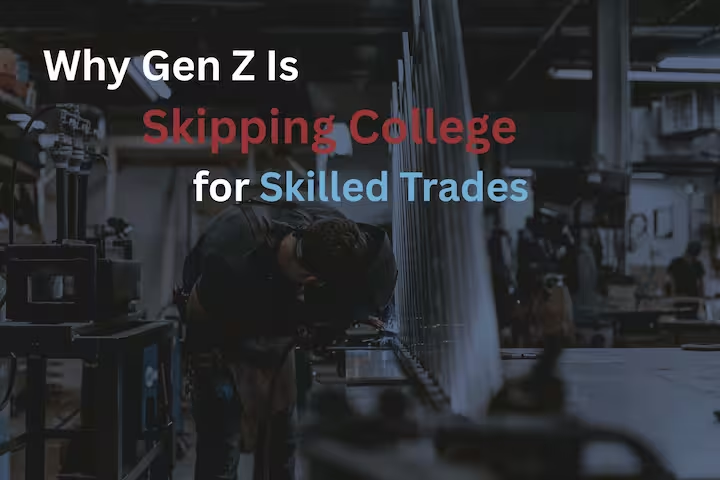
Gen Z Is Skipping College for Skilled Trades — Smart Move or Big Risk?
- Vikram Singh Shahi
- Culture , Lifestyle , Trending
- February 9, 2026
For years, the script was simple: finish school, go to college, get a stable job. But for a growing number of Gen Z, that script is breaking.
College enrollment in the US has dropped by about two million students since 2011. At the same time, vocational and trade school enrollment is up sharply, and starting pay for skilled workers has climbed more than 25% since 2019. Instead of four years on campus, more young people are choosing welding torches, lawn care businesses, and other blue‑collar careers.
Is that a smart move — or a long‑term risk?
Why Gen Z Is Questioning the College Default
A four‑year degree is still valuable. But for many, it’s stopped feeling realistic or safe.
- Costs exploded. In the last decade, average annual tuition at private colleges rose ~42%, and at public universities ~30%. A full four‑year degree can easily run from $110,000 (public) to $225,000 (private) when you add tuition, fees, and living costs.
- White‑collar jobs feel less secure. Big tech and finance companies that once looked “safe” — Google, Amazon, PayPal and others — have all announced large layoffs in recent years.
- Debt feels heavier than ever. Taking on five figures of student debt with no guaranteed outcome feels like a bigger gamble than it did a generation ago.
Against that backdrop, the trades and blue‑collar work suddenly look less like a fallback and more like a real option.
The Other Path: Trade School, Tools, and a Paycheck
The video this article is based on highlights stories like Morgan Bradbury and Chase Gallagher — two Gen Z workers who skipped, paused, or replaced college with hands‑on careers.
Morgan: From Eagle Scout to Welding Navy Ships
- Planned to study engineering or physical therapy.
- Discovered welding through an Eagle Scout merit badge and “was instantly hooked.”
- Took a 9‑month welding certification course at a trade school instead of a 4‑year degree.
- Paid about $22,000 in tuition — a fraction of a typical college bill.
- Landed a welding job with BAE Systems before she even finished, earning around $57,000/year at 19.
- Now, as a second‑class welder working on US Navy ships, she has multiple certifications and a clear career path.
Trade school didn’t just give her a skill; it put her in a real job, fast, with room to grow.
Chase: Turning Lawn Mowing Into a Seven‑Figure Business
- Started mowing lawns as a young teenager.
- Convinced his parents to let him do online high school so he could work on his business during the day.
- By the time he graduated, he had $120,000 saved.
- Instead of spending it on tuition, he invested it back into his company.
- In 2024, his landscaping business did over $1 million in sales, and his salary + owner’s share was nearly $500,000.
He didn’t just avoid debt — he built an asset.
The Numbers Behind the Shift
Some of the trends mentioned in the video:
- College enrollment: Roughly 2 million fewer students in traditional four‑year universities compared to 2011.
- Costs:
- ~$110,000 all‑in for a four‑year public university
- ~$225,000 all‑in for a four‑year private school
- Vocational school boom: From 2019 to 2024, overall undergrad enrollment ticked up just 1%, while vocational enrollment jumped ~18%.
- Skilled‑trade pay: Since 2019, average starting pay for skilled workers is up more than 25% (from about $18.70/hour to roughly $23.43/hour).
- Hiring: Net hiring of new blue‑collar workers has stayed stronger than for white‑collar grads of the same age.
For Gen Z looking at the math, the message is clear: skilled work pays better than it used to, and it’s in demand.
Why Skilled Trades Are Suddenly “Cool” Again
Several forces are pushing demand for blue‑collar work:
- Retiring baby boomers. Many older skilled workers are aging out of the workforce, leaving gaps in construction, manufacturing, shipbuilding, and home services.
- Big infrastructure spending. Recent US laws like the Bipartisan Infrastructure Act and the CHIPS and Science Act are pouring money into roads, bridges, factories, and energy — all of which need people who can actually build things.
- Faster path to earning. A one‑ or two‑year program (or even a certification) gets you to a paycheck much faster than a four‑year degree.
- Upside for entrepreneurs. Trades like landscaping, HVAC, plumbing, welding, and electrical work all have one thing in common: once you’re good, you can start your own shop.
For many Gen Z workers, that mix of practical skills + real demand + entrepreneurial upside feels more appealing than an expensive degree plus an uncertain white‑collar job hunt.
Is Skipping College Always the Right Move?
No — and this is where the nuance matters.
College still makes sense when:
- You want to work in fields that require degrees or licenses (medicine, law, many engineering roles, academia).
- You can attend without taking on crushing debt (scholarships, strong financial aid, in‑state tuition, or family support).
- You value the broader experience — networks, research, campus life, and deep specialization.
Trades or entrepreneurship may make more sense when:
- You’re drawn to hands‑on work and real projects, not lectures.
- You want to avoid or minimize debt and start earning sooner.
- You’re comfortable with variable income, seasonality, and the responsibility that comes with running or growing a business.
The real question isn’t “college or no college?” — it’s “what problem do you want to solve, and what’s the most honest path to get there?”
Risks and Trade‑Offs of the Blue‑Collar Path
Skilled trades and self‑employment come with their own challenges:
- Physical demands: Many trades are hard on the body — long hours, heavy lifting, uncomfortable environments.
- Economic cycles: Construction, manufacturing, and home services can be hit by recessions or policy changes (for example, new tariffs that raise material costs).
- Seasonality: Work (and income) can spike in certain months and slow down in others.
- Responsibility: If you run a business, you’re not just doing the work — you’re also handling clients, payroll, marketing, and taxes.
For people like Morgan and Chase, those trade‑offs feel worth it. But it’s not an “easy” path — it’s just a different one.
How to Decide: Questions to Ask Yourself
If you’re on the fence between college and a skilled trade, ask:
- What kind of work do I actually enjoy — hands‑on, abstract, or a mix?
- What will this path really cost me in money and time? (Not just tuition, but years not earning.)
- What does demand look like where I live — and where I might move?
- Am I okay with risk and responsibility, or do I want something more structured?
- Can I test this path cheaply? (Internship, part‑time work, short course, job shadowing.)
The stories in the video don’t “prove” that everyone should skip college. They prove there are more valid paths than one.
Final Thoughts: A New Definition of Success
For decades, success was framed as a straight line: school → college → office job. Gen Z is quietly rewriting that story.
Some will still choose four‑year degrees — and for many careers, they should. Others will pick up tools, start small businesses, or learn skills that are desperately needed but often overlooked. Both paths can be smart. Both can build a stable, meaningful life.
What’s changing is this: the “right” path is no longer one‑size‑fits‑all.
Watch the Full Story
This article references a segment by CNBC that explores why many Gen Z workers are choosing skilled trades over traditional college paths.
You can watch the full video here: