Domestic AI Robots Are Coming — Will They Replace Human Home Help?
- Vikram Singh Shahi
- Technology , Lifestyle , Ai
- February 11, 2026
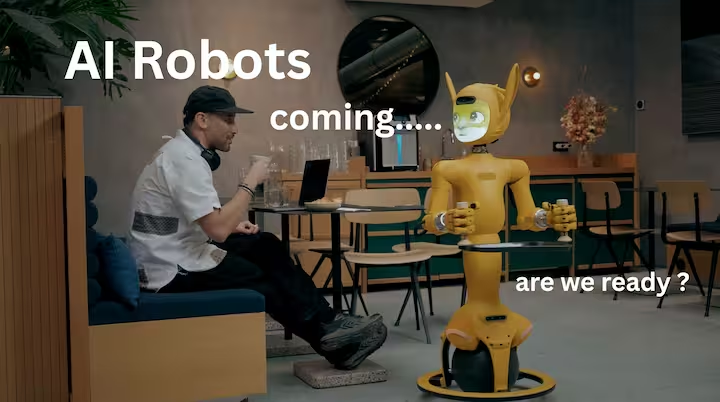
For years, the idea of a robot butler was pure sci‑fi. Now, billions of dollars are flowing into startups racing to build domestic AI robots that can tidy your living room, fold laundry, wipe counters, and maybe even make your coffee.
From tele‑operated humanoids to fully autonomous bots trained on thousands of hours of human chores, a real home robot market is taking shape. The big question is no longer “will this exist?” but how soon it will be useful enough to replace parts of traditional domestic help — and what that means for the rest of us.
The New Frontier: AI Robots for Everyday Chores
Across Silicon Valley and beyond, companies are building robots specifically for normal homes, not just factories or labs:
- Some teams use teleoperators in VR headsets, remotely controlling robots so the AI can watch and learn how to clean, tidy, and handle objects safely.
- Others are training robots with one large neural network that controls the whole body, letting a bot “see” the world through cameras and sensors and then move on its own.
- Startups are deploying robots in real environments like laundry facilities, slowly improving speed and reliability by folding clothes all day, every day.
The goal is simple but incredibly ambitious: a general‑purpose home robot that can understand a messy room, decide what “clean” looks like, and then do the work with minimal human supervision.
How Domestic Bots Learn: From Human Drudgery to Machine Skill
Unlike chatbots, which can be trained on text scraped from the internet, home robots need very specific, physical data:
- People wear sensor gloves or full suits while doing chores in their own homes, generating rich motion data.
- Cameras and sensors record hundreds of different kitchens, living rooms, and laundry piles, capturing all the small variations in how people actually live.
- Robots like laundry‑folding bots spend months on a single task, shaving seconds off folding time as the AI improves.
In some companies, early customers and staff effectively become a “robot teaching army” — repeating the same tasks so that neural networks can learn how to grip, lift, turn, twist, and place common household items.
It’s slow and imperfect today, but each iteration gets:
- More accurate (fewer dropped cups and mangled t‑shirts)
- More general (able to handle different handles, fabrics, layouts)
- More continuous (able to run for hours, not minutes)
What These Robots Can Actually Do Right Now
Despite the hype, most domestic bots today are still in an early adopter phase:
- Some can clear tables, wipe counters, and reset rooms, often with a mix of autonomy and remote human assistance.
- Laundry bots can already fold clothes neatly, even if they’re still slower than a human — but they can run all day without getting tired.
- Humanoid prototypes are being tested to water plants, tidy surfaces, and handle basic household objects, with people stepping in via VR when the AI gets confused.
In many cases, the reality is a hybrid system:
- The robot handles easy parts of the job on its own.
- When it gets stuck, a remote operator briefly takes over, then hands control back to the AI.
- Every intervention becomes new training data, making the robot a little more capable next time.
It’s not a perfect “robot maid” yet — but it’s clearly more than a science‑fair demo.
Will Domestic Robots Replace Human Home Help?
Domestic AI robots are likely to change home help before they fully replace it.
In the near term, robots will:
- Take over repetitive, low‑skill chores like folding laundry, picking up toys, or wiping surfaces.
- Act as multipliers for humans — one person could supervise or manage several bots across multiple homes or buildings.
- Make certain services (like regular tidying or laundry) cheaper and more consistent, especially in high‑income areas.
For many households, that means:
- Some families who could never afford full‑time domestic help might still pay for a robot subscription or service.
- Housekeepers and cleaners may shift toward higher‑value tasks — organizing, deep cleaning, child care, cooking, and household management — while leaving basic drudgery to machines.
Over a longer horizon, if robots become cheaper and more capable, they could replace a significant share of traditional domestic work. But that will depend on:
- How quickly costs fall
- How reliable and safe the bots become around children, pets, and clutter
- How comfortable people are with cameras and remote control inside their homes
Social and Economic Impact: Not Just Convenience
Domestic AI robots are more than just cool gadgets. They have real societal implications:
- Labor markets: In regions where many people rely on domestic work for income, widespread robot adoption could disrupt jobs — while also potentially creating new roles in robot supervision, maintenance, and operations.
- Aging populations: For older adults or people with disabilities, reliable home robots could enable more independent living, helping with routine tasks and reducing reliance on family members or caregivers.
- Inequality: Early robots will be expensive, likely starting around the price of a car. That means wealthier households will benefit first, while others may only see changes indirectly through service providers.
There are also privacy and safety questions:
- Tele‑operated or remotely assisted robots mean strangers could be “inside” your home digitally, even if just to help the AI learn.
- Companies must design strict safeguards so that home robots don’t become roaming cameras that can be abused or hacked.
- Child safety, physical reliability, and fail‑safes will all have to be rock‑solid before mass adoption.
How Domestic Bots Could Still Benefit Society
If developed and regulated thoughtfully, domestic AI robots could contribute positively to society:
- Reducing unpaid labor: A huge amount of housework is still done as unpaid, invisible labor. Offloading repetitive chores can free up time for education, rest, caregiving, or paid work.
- Supporting caregivers: Parents and professional caregivers could spend more time on emotional and relational work, less on endless cleaning and tidying.
- Driving new skills and industries: Robotics, home AI, remote tele‑operations, and maintenance services could become major employment sectors in their own right.
The key is making sure the benefits don’t only flow upward to a handful of tech giants and wealthy households, but also create fair opportunities and protections for workers whose roles are changing.
The Road Ahead: From Hype to “Normal”
Some industry groups think it might take 20 years before humanoid domestic robots are truly common and trusted. But we’ve heard similar timelines before for other technologies:
- Driverless cars looked far‑off for years, then quietly became everyday vehicles in certain cities.
- Smart speakers and robot vacuum cleaners went from novelties to normal household appliances in under a decade.
Most likely, domestic AI robots will follow the same path:
- First, as expensive, glitchy early‑adopter gadgets.
- Then, as more capable, safer, and cheaper helpers.
- Eventually, as something many households simply expect to have — like a washing machine or a dishwasher today.
Watch the Full Report on Domestic AI Robots
This article is based on a detailed video report that visits multiple robotics companies, shows real demos, and explores the race to build a useful home robot. To see the bots in action and hear directly from the founders, watch the full video here:
Domestic AI Robots — Inside the Race to Build a Home Helper Bot (YouTube)